
What to do at Lake Bohinj: The joy of the outdoors in the Julian Alps
Lake Bohinj is a paradise for anyone who enjoys active outdoor adventures. Between the staggering mountains, crystal-clear water and unexpected surprises – like hidden waterfalls – there’s an awful lot to love here, and an awful lot to do. Discover my favourites from our summer stay here, in my guide to exploring Bohinj.
If Ljubljana is Vienna’s laid-back cousin, then Lake Bohinj is what Bled must have been like before it grew up (and attracted the attention of the crowds). Bohinj feels young, wild, exciting – whilst Bled is a little more refined and grown up.
Situated on the edge of the Triglav National Park in the Julian Alps, Lake Bohinj is the largest lake in Slovenia. The Bohinjska valley, scattered with small villages, is a picturesque pairing to the lake. And whilst visitors do flock here during the summer, it somehow doesn’t seem crowded or spoiled. Everyone’s here to enjoy the lake and the mountains – and as they dissipate around the lakeside, in the woods and the pastures, it feels like there’s plenty of room to share.
And if there’s one overriding feeling you get here, it’s that there’s an abundance of things to do.
If, like me, you love active, outdoor holidays – then Bohinj is just perfect.
We spent five days here and I could have happily stayed for more. We only scratched the surface of what there is to do around Lake Bohinj, so don’t believe anyone who tries to tell you that it’s just a day trip from lovely Ljubljana. In this guide I’ll share my suggestions for how to spend your time here, whether you’re planning a few hours, a day or more. Let’s begin.
There’s no AI here! Every post on Travels with a Saddle Bag is written by myself and based on my own travels. This post was written in September 2018 and last updated in December 2024, based on my visit to Lake Bohinj in August 2018.
A quick introduction to Lake Bohinj
Bohinjsko Jezero, or Lake Bohinj, is located just over an hour north of the capital, Ljubljana. Nestled in a steep valley on the edge of the Triglav National Park, not far from both the Italian and Austrian borders, it’s well and truly Alpine in look and feel. The lakeside itself is remarkably undeveloped, giving Bohinj a beautifully wild feel.
Beyond the end of the lake, there’s a scattering of communities in the Bohinjska valley. Bohinjska Bistrica is the largest and the municipal centre, the others are much smaller, traditional farming villages. Amongst the discrete apartments and little guesthouses catering to visitors here, there are old-fashioned dairies and sprawling vegetable gardens that haven’t changed in centuries.
Closest to the lake are the villages of Ribčev Laz and Stara Fuzina. Ribčev is more modern and closest to the water. With good transport links it’s a great base if you’re travelling without a car. We stayed here and were really pleased with our choice. Stara Fuzina is larger – but undeniably pretty. The village is brimming with beautiful farmhouses and ancient wooden hayracks, giving it a delightfully different atmosphere to Ribčev.

What to see and do at Lake Bohinj
To help you plan the perfect time at Lake Bohinj, I’ve grouped our favourite activities by the length of time they took. This way, you can mix and match to suit your length of stay – or the weather.
If you’ve got an hour or two
- Walk to the viewpoint at Peč
- Take a paddle board or kayak out on the lake
- Relax by the lake
If you’ve got half a day
- Visit Savica waterfall
- Explore the Mostnica gorge
- Hike to Vogar for coffee, cake and a spectacular view
- Walk to Rudnica for a view of the valley and villages
If you’ve got a whole day
- Follow the lakeside path – with a detour to Savica waterfall
- Head up to Vogel and explore the mountain
- Take a day trip to Lake Bled

What to do with an hour or two at Lake Bohinj
Head to the viewpoint at Peč
Arriving at Ribčev Laz, you’re greeted by the water stretching blue in front of you and peaks beyond. It’s rather beautiful, but there’s an even better view not so far away. Just behind the church, a forested hill rises a short way. This is Peč, and there’s a fabulous (and quiet) little viewpoint hidden amongst the trees.
Follow the road past the church in the direction of Stara Fuzina, and take the first right turn you see (a couple hundred metres away). After a few dozen more metres you’ll see a signpost pointing left onto a leafy footpath. The signs will set you on the right route, and half an hour of gentle walking will bring you to the top of Peč. From here, there’s an unbroken panorama of the water that’s not easy to forget. We came up here relatively early in the morning, but I suspect it’s even more spectacular at dawn or dusk.

Paddle board or kayak on Lake Bohinj
There are few places I’ve been that seem more perfect for a paddle than Lake Bohinj. It’s also a great way to get an alternative view of the landscape, and frankly, just to enjoy splashing about on the water.
We hired paddleboards at AlpinSport right by the river in Ribčev Laz. An hour will give you more than enough time to explore the bay and beach areas at this end of the lake – but if you’re more experienced or feeling adventurous, you could certainly go further afield and have a lot of fun.
Oh, and if you’ve never given it a go before – don’t worry. There are plenty of others on the water, and it’s easy to pick up.
Explore the lakeside
However long your stay, make sure you put aside some time to simply enjoy the water. In summer, make like a local and head to the beach near Stara Fuzina or Ukanc. The gravelly waterfront at Ribčev Laz is also popular with families, as there’s shallow water to be found here. Rock up and enjoy a picnic, laze in the sun with a book – or hop right in. In August, the water is warm and unbelievably clean and clear.
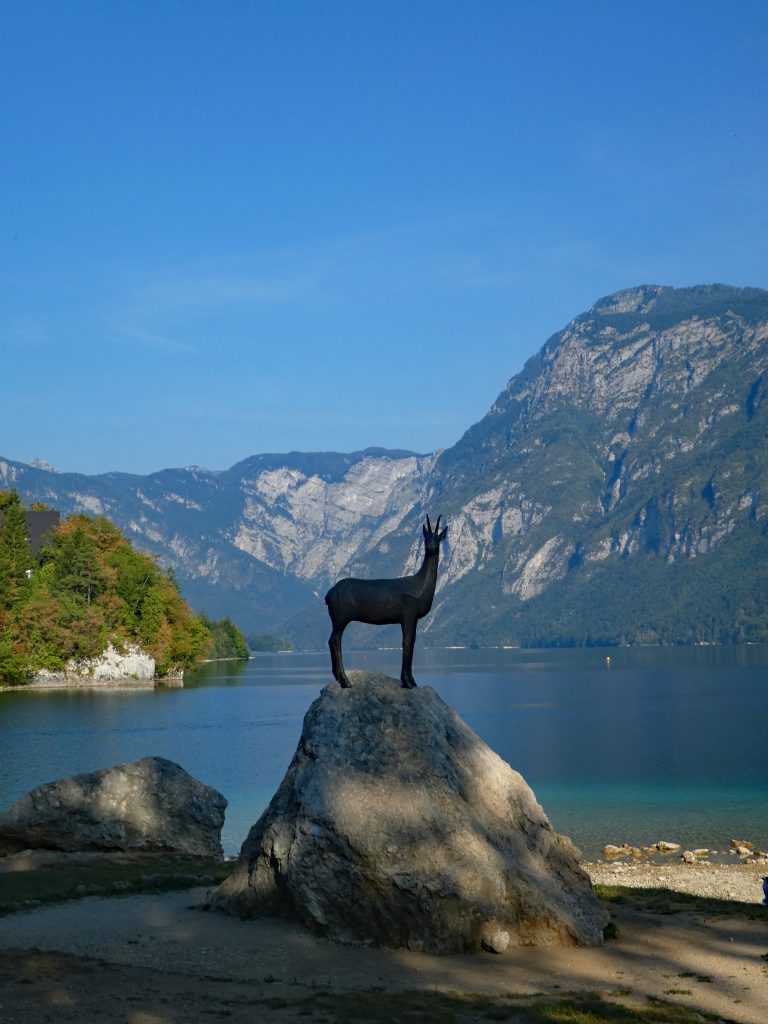
If the weather’s cooler it’s still a pleasure to stroll along the waterside paths. Check out the statue of the mythical Zlatorog that protects these mountains, just outside Ribčev Laz.
What to do with a half day at Lake Bohinj
Chances are, you’re not going to have half days to fill here. But consider sandwiching two half day activities together for a full day of fun. Or if it’s hot, enjoy a shorter activity in the morning and head to the lakeside in the afternoon and get in or on the water.
Visit Savica waterfall
Head to the far end of Lake Bohinj and you’ll find four things; Vogel lift station (more about this later), the petite village of Ukanc, an enormous campsite – and Savica. It’s a bit of a hike from the lakeside (although you can drive to a car park near the entrance) but it’s very much worth it.
Savica is a sparkling cascade of water that pours down the mountainside into the most incredible blue-green pool. It may not be big, but my gosh it’s beautiful. There’s something very special about the clarity and colour of the water in the Julian Alps that makes this place unexpectedly spectacular.
You’ll need to pay entry to the relatively short, stepped, path up to the waterfall. But as I often say, if it costs less than a fancy cup of coffee it’s always worth a punt – and in this case it absolutely is.

Explore Mostnica Gorge
Water features are a bit of a theme in the Julian Alps. And you might understandably wonder if it’s really worth going to see another river and paying for the privilege of it.
Normally I’d agree. But in this part of the world I had to make an exception. Mostnica is worth half a day of anyone’s time, and the requisite €3.
A stone’s throw from the village of Stara Fuzina, Mostnica Gorge is completely different in character to both Savica and Vintgar (near Lake Bled), and deserves more of your time. The entrance fee gives you access to a 4km path stretching from the valley bottom to a waterfall at its head. It’s a decent walk, especially if you follow the path all the way up and back. Even as pretty brisk walkers we happily whiled away more than three hours here.

The lower parts of the path straddle the river closely, where it leaps from pool to pool in cascades of sapphire blue water. The path remains in the shade of the cool woodland, but in places it’s easy to clamber down to the waterside. We found lots of families picnicking and even swimming in the river where it was shallower and slower flowing. About half way along the path, just as it’s starting to steepen and meander into the woods, it emerges out into alpine meadow at a chalet (that’s perfect for a cold drink). From here the route mostly traverses pasture, speckled with fruit trees and little summer chalets, before plunging back into the woods just as you reach the waterfall.

If you’re keen to explore just the river, stick to the lower half of the path. Beyond this point, it’s all about meadows until you reach the craggy rock face at the falls. But do consider heading on up and exploring the beautifully peaceful landscape that’s so different to the valley floor.
Climb to Vogar
For one of the very best views over the lake, it’s worth the steep climb to Vogar from Stara Fuzina. This peak sits on the northern side of the lake, directly above the water.
The path up is easy to follow from the Mostnica Gorge car park just above the village. After weaving through fields for a few minutes, it then peels away from the private road and heads up through the woodland. It’s a 500m ascent up a bouldery path that had us both sweating buckets! But, when you reach the top it’s entirely worth it.
Towards the head of the trail a small path strikes off to the left, and after a few paces you find yourself at the vertiginous paragliding spot above the beach. It’s actually a great place to stop and catch your breath, and watch the paragliders sweep off the mountainside if the conditions are good.
Back on the main path, you’ll reach a chalet shortly, with the catchy name of Kosijev dom na Vogarju. It’s a lovely place with a huge shady terrace and excellent strudel (well, you’ll have burned a fair few calories on the way up).
Don’t head back down the mountain without following the small signpost on the terrace railings pointing you towards another viewpoint. This one is pretty magical. There’s a beautiful bench here to sit on and drink it all in.
From the chalet, you can head back down the way you came up. Or, if you’re feeling ambitious, there are more tricky trails beyond. We explored most of the route to Přsivec, a good 1,000m up from the valley floor. It’s awe-inspiring stuff, but the paths aren’t particularly well signposted, so you’ll need to be prepared with a good map, GPS and some common sense when it all gets a little off-piste.

Valley and villages via Rudnica
If checking out the viewpoint at Peč sounds appealing, but you’ve got a little more time, consider extending the walk to include the higher viewpoint at Rudnica. The route starts in the same place, but after exploring Peč, head back to the main trail and follow the signposted paths to Rudnica, another 45 minutes uphill.
The trail weaves its way pleasantly through beech woodland before reaching a couple of Alpine meadows near the top. The last five minutes of the climb plunge back into the woods once again. You know you’ve reached the top when a view appears through the trees and a small metal box (containing a visitors log) anchored to a rock marks the spot.
The panorama here is completely different, as you’re looking away from the lake. Instead of mountains, a patchwork of fields and small villages – alongside the town of Bohinjska Bistrica – opens up beneath you.
If the landscape below looks enticing, follow our lead and take an alternative path down signposted at first to Stara Fuzina and then to Studor. Down in the valley, you’re not much more than a kilometre or so in either direction from the villages of Studor, Srednja Vas and Stara Fuzina. Each are worth more than five minutes of anyone’s time. They’re pretty little alpine communities full of beautiful old houses, blooming flower baskets and vast old wooden barns. Have a stroll, stop for a coffee, enjoy a different side to the Bohinjska valley.

What to do with a day at Lake Bohinj
There are some things best enjoyed with a full day dedicated to them – these were my favourite.
Circumnavigate Lake Bohinj
You could make this an ambitious half day walk. But I’d recommend taking your time and seeking out some mini adventures along the way.
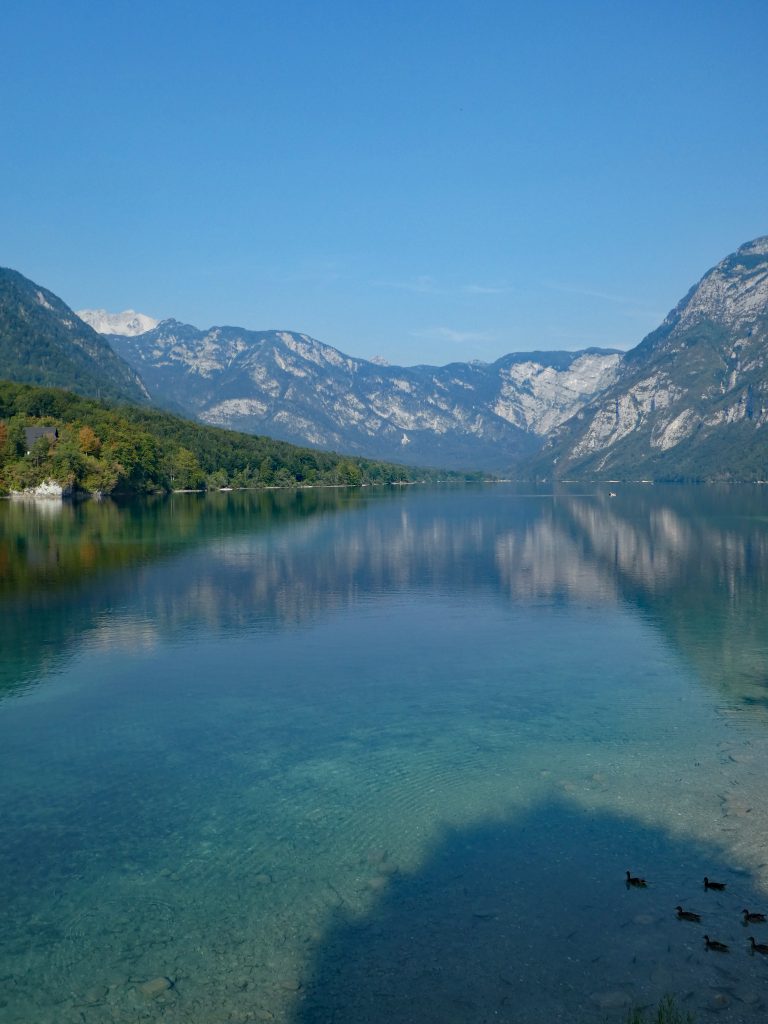
Along the south side of the lake, there’s an easy to follow path along the roadside. It’s pleasant enough, but we found a much nicer footpath that tracks along the hillside a little way off the road. It’s not high enough to be a real climb, but it is high enough to be treated to a panorama of the water below whenever there’s a gap in the trees. The deciduous woodland is leafy, cool and quiet – and positively brimming with wildflowers and insects.
About an hour and half of walking takes you from Ribčev Laz to the Vogel ski station lift. From here, it’s a pleasant stroll along the now very quiet road into the village of Ukanc at the far end of the lake.
At this point, you could continue around the lake for a shorter walk. But I’d really recommend making a detour to the waterfall at Savica like we did. It’s much nicer to arrive here on foot than by car, and whilst it’s a couple of kilometres walk from the village, it’s not a difficult route. There are some great picnic spots on the path up to the falls and two nice looking cafes near to the entrance, so now is the perfect time for a lunch stop.
Returning to Ukanc, there’s a left turn onto the path that tracks the northern shore of the lake. Here you get to go a little off-road again as this trail isn’t tarmacked. The path is narrow at first, but gets progressively wider. You’ll scramble in and out of the trees, but you’ll get a completely different view of the lake – and one that can’t be reached by car. You’ll emerge from the woods close to the beach area between Stara Fuzina and Ribčev Laz. If it’s a hot day, a stop for a paddle is fairly irresistible at this point.
Head up to Vogel
Hands down my favourite thing we did during our stay in Bohinj.
Vogel is both a mountain and a small ski resort. It warrants a whole day of your time as it requires a return ride in the cable car up to the ski station, where most of the walking routes begin. This will set you back €30, but it is very much worth it.
You can visit the ski station (at the top of the cable car) without tackling the mountain, but we came to hike. I’d recommend a proper walking map for any routes high up or off the beaten path here, but you can also pick up a free trail map at the cable car which highlights some of the signposted routes.
We decided to head to the ski station’s namesake, Mount Vogel. The first part of the route rather counter-intuitively takes you downhill through flower-carpeted woodland to a chalet named Zadnji Vogel. But not far beyond the chalet, the path takes a left turn into the most beautiful bowl-shaped valley, and starts to climb steeply amongst the pasture and rocks. As the path rises, the rock under foot gives way to scree and the path levels out a little. The peaks above you become closer and closer and the views even more staggering.
At the next obvious junction in the path, the route takes another left turn and becomes narrower with steeper drops to the side and more boulders to climb over. You reach a Col and all of a sudden can see down into the sweeping valley below, blue with haze on the day we visited. Vogel comes into view and the path tracks in its direction, the majority of the climbing now done.

The last few hundred metres of climb are very narrow and mostly on scree. As we didn’t have poles with us or our winter hiking boots on we called it a day at this point. Better to be safe. But it didn’t matter, we still had the most wonderful panorama to enjoy.
We took a meandering route back, traversing the scree and gorse strewn slopes of Voglarski Skakavec. After scrambling across the mountainside we were eventually greeted with the short but steep climb of one of the pistes leading down from Orlova Glava. One last effort took us to its top, where we found a cluster of ski lifts and chalets. There’s also a little rocky outcrop topped with a cross and wishing bell that’s worth heading to for another spectacular view (if you’ve not had enough of these yet).

It’s a gentle meander down the piste to the main Vogel lift station for the return into the valley. There’s a handful of places to stop for a drink or bite to eat here if you’d like to spend a little longer on the mountain.
Take a trip to Lake Bled
If it’s not already part of your travel plans, take a day trip to Bohinj’s rather charming neighbour. There’s plenty to explore both on and off the beaten path.
There are frequent (and very affordable) buses that run all day between the villages in the Bohinjska valley and Bled. It takes just over half an hour, which gives you plenty of time to make the most of your day.
My guide to Lake Bled, on and off the beaten path, will give you plenty of inspiration for a day or more.

Lake Bohinj travel resources
How to get to Lake Bohinj
Bohinj is just over half an hour from Lake Bled, or a little under an hour and a half from Ljubljana. Bus services are frequent, cheap and comfortable and most run to Bohinjska Bistrica, Ribčev Laz and Stara Fuzina. There are less frequent scheduled services to the smaller villages throughout the day. Check the Alpetour website for timetables and more information.
Alternatively, whilst costing considerably more than buses, shuttles can be a useful option if you’re travelling at quieter times of day or year. And if you’re driving, Bohinj is signposted from Bled. Leave the motorway following the signs to Bled, then pick up those to Bohinj once you hit the town centre.
How to get around Lake Bohinj
Bohinj is very pedestrian friendly, and there’s no better way to get around here than on two feet or two wheels. Hop-on-hop-off buses also run regularly throughout the summer months to all the villages in the valley and are by far the easiest way to get around if you’d prefer not to walk. Expect to pay €2 for a 24 hour travel card (2024). Parking is increasingly limited and expensive close to the lake, and visitors are encouraged to park further down the valley and take a bus to the waterside to ease congestion.
Where to stay at Lake Bohinj
Camping and self-catered accommodation is popular here, although there are guesthouses and a small selection of eco hotels further from the lakeside. Ribčev Laz and Stara Fuzina are ideally located for self-catering close to the lakeside. The popular Camp Bohinj at Ukanc offers the only place to stay with unspoilt views across water. We rented a modest studio in Ribčev Laz and found it the location perfect for exploring, but we would have appreciated the better access to local shops and cosy places to eat in Stara Fuzina.
What to pack for a trip to Lake Bohinj
Check out my suggestions in What to pack for the Alps in summer: A girl’s guide.
Why we fell under the spell of Lake Bohinj
Bohinj was everything I’d hoped for – and more.
If, like us, you love being in the great outdoors and exploring on foot, there is an abundance of things to do here that’ll keep you happy for a week or more. And there’s an embarrassment of natural beauty. Add into the equation that it’s astonishingly good value for money for an Alpine escape in peak season, and you’ll find it hard to resist.
Get here before the crowds do. Bohinj is magic.
Planning a trip to Slovenia? Check out How to plan the perfect trip to Slovenia.


